An example specification.

A car wash owner wants to sell wash packages online. This is the specification that idea becomes, followed by the review notes that show how it got there.

This example is illustrative. The idea was written for testing, and decisions marked Illustrative were added to show a finished specification.

Overview

The idea
Sell car wash packages online, with a time limit for using the washes.
What was clarified
Who can use the washes, when the time limit starts and ends, how long it lasts, and what stays outside this specification.
What it contains
6 requirements, each with a worked example, and 6 pass/fail checks that cover them.
Price for this scope
6 requirements × US$150 = US$900. How pricing works

Specification

Final, approved version

What the owner approves and shares with a developer. Gold marks the words a decision settled.

Car wash packages: specification

R1Packages

The owner offers packages with a set number of washes, such as 2 or 5, each at a price the owner sets. Every package covers the same wash.

Worked example

Tom sees a package of 2 washes and a package of 5, each with its own price.

Owner’s words

“like two car washes for certain money, 5 car washes for certain money”

Illustrative decision

Every package covers the same wash.

R2Buying online

A customer buys and pays for a package online, giving the licence plates of up to two cars. The washes are then theirs to use.

Worked example

Tom buys the 5-wash package online, enters his plate and his wife’s plate, and pays. His record shows 5 washes and both plates.

Owner’s answer

“Up to two cars. The customer gives both licence plates when they buy a package.”

R3Listed cars only

Washes from a package can be used only for the cars whose plates were given at purchase. Any other car is refused.

Worked example

Tom’s wife brings her car in and uses one of his washes. His brother’s car comes in and is refused.

Owner’s answer

“Up to two cars. The customer gives both licence plates when they buy a package.”

R4Counting down

Each wash used takes one wash off the package.

Worked example

Tom has 5 washes. After his first wash he has 4 left.

Owner’s words

“like two car washes for certain money, 5 car washes for certain money”

R5Eligibility period

Washes can be used only during an eligibility period of 14 days, the same for every package. The period includes its last day. Unused washes expire when it ends.

Worked example

Lena’s first wash is on 1 March. A wash on 14 March is accepted. On 15 March her unused washes have expired.

Owner’s words

“I also want to have an eligibility period for those purchased car washes.”

Owner’s number

14 days.

Illustrative decision

The same period for every package, and the period includes its last day.

R6Period start

The period starts on the day of the customer’s first wash from the package.

Worked example

Tom buys 5 washes on a Monday and comes for his first wash weeks later. His period starts on the day of that first wash.

Owner’s choice

“Starts at the first wash”

Outside this specification

  • How a wash is recorded at the station. The owner will settle it later.
  • Changing a licence plate after buying.
  • Packages that renew automatically.
  • Refunds for unused washes, and how to account for washes paid for and still unused.

Agreed with the owner for this version. Illustrative.

What the developer decides

Screens and design, the payment provider, the technology and hosting, and the quality and security of the code.

Checks

Final, approved version

Each check is a written scenario: a starting point, an action and the result to expect. Each names the requirements it covers.

C1

covers R3

Start

Tom bought 5 washes and gave two plates, his car and his wife’s car. He has 5 left.

Action

His wife’s car comes in and uses one of his washes.

Expected

The wash is accepted, and Tom has 4 left.

Then

A third car, whose plate Tom did not give, tries to use one of his washes.

Expected

The wash is refused, and Tom still has 4 left.

Catches

A build that ties washes to one car only, or lets any car use them.

C2

covers R2

Start

Tom is buying a 5-wash package online.

Action

He enters two licence plates and pays.

Expected

His record shows 5 washes and both plates.

Then

Lena buys a package and tries to enter a third plate.

Expected

Only two plates can be given.

Catches

A build that asks for no plates, or allows more than two cars per package.

C3

covers R6 and R5

Start

The period is 14 days. Tom bought 5 washes 15 days ago and has not used any.

Action

Tom uses a wash today.

Expected

The wash is accepted, and he has 4 left.

Then

Lena’s first wash was 15 days ago, she has 3 left, and she tries to use another.

Expected

The wash is refused.

Catches

A build that starts the period on the day of buying, so Tom is refused.

C4

covers R4

Start

Tom has 2 washes left.

Action

He uses a wash, then another.

Expected

He has 0 left.

Then

He tries a third wash.

Expected

The wash is refused.

Catches

A build that sells packages but does not count washes down.

C5

covers R5

Start

The period is 14 days and Lena’s first wash was on 1 March.

Action

She comes for a wash on 14 March, and again on 15 March.

Expected

The wash on 14 March is accepted. The wash on 15 March is refused.

Illustrative decision

Catches

A build that ends the period a day early or a day late.

C6

covers R1

Start

The owner has set a 2-wash package and a 5-wash package, each with its own price.

Action

A customer opens the page to buy washes.

Expected

Both packages show, each with the price the owner set.

Catches

A build that shows one package, or prices it wrongly.

Coverage: every requirement and the checks that cover it
RequirementCovered by
R1C6
R2C2
R3C1
R4C4
R5C3, C5
R6C3

Review notes

Reviewed draft

About this example

The idea was written for testing. Our free demo wrote the first draft, shown here with light edits for reading, and the owner’s answers in it come from that run. Decisions marked Illustrative were added for this example, so you can see a finished specification. The review notes were written to show what expert review adds to a first draft.

The idea, as typed

49 words

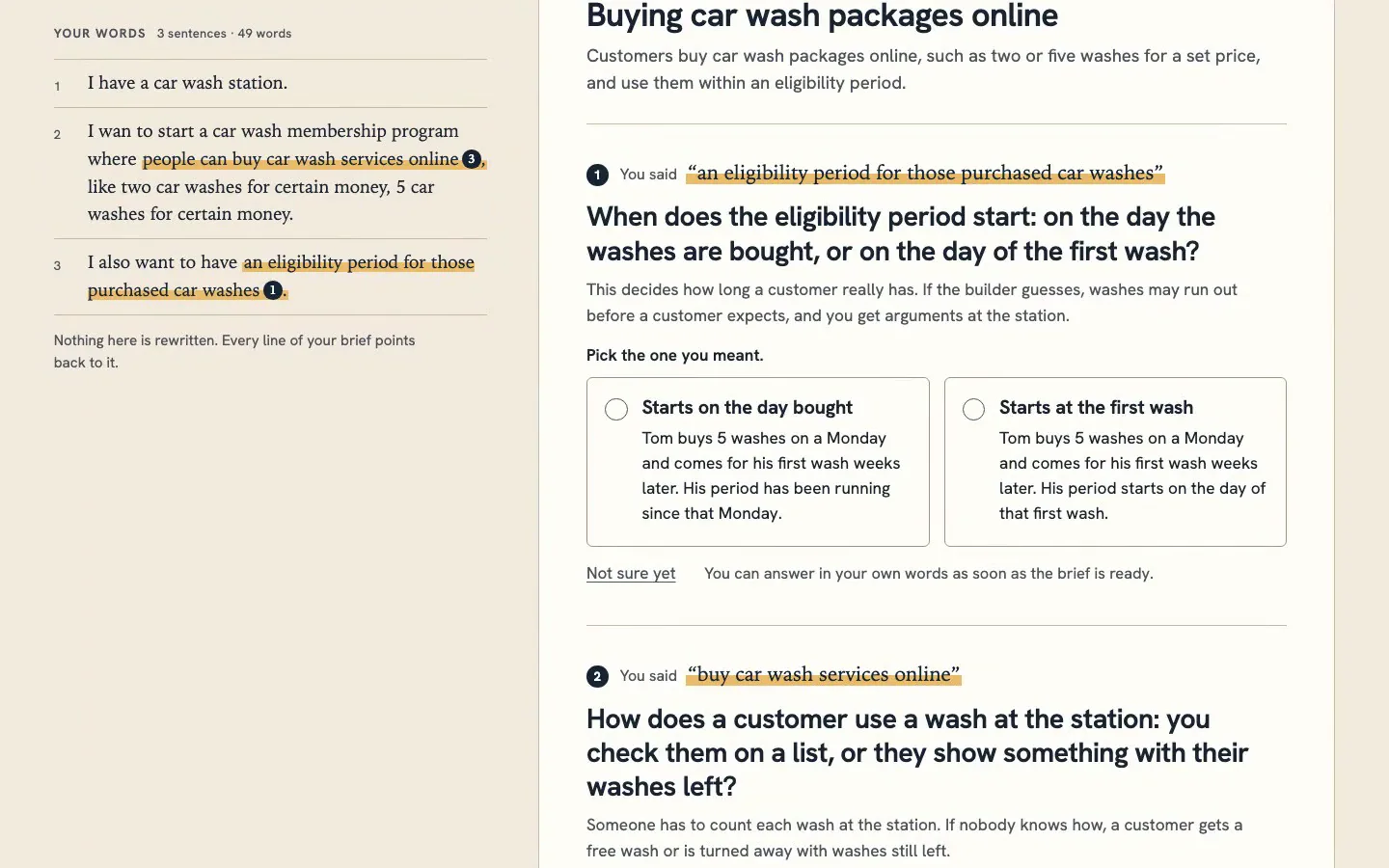
I have a car wash station. I wan to start a car wash membership program where people can buy car wash services online2, 3, like two car washes for certain money, 5 car washes for certain money. I also want to have an eligibility period for those purchased car washes1.

What review changed

  1. Updated check C3 to the owner’s number. The first draft still tested a 30-day period after the owner changed it to 14.

  2. Mapped C3 to R5 as well as R6. Its second step already shows a wash refused 15 days after the first wash.

  3. Added C6, because R1 had no check.

  4. Added C5 for the last day of the period, and raised the question it depends on.

  5. Listed the questions to settle before building. Each is in the table below, with how it was settled.

Questions and the owner’s answers

Question 1, on phrase 1

When does the eligibility period start: on the day the washes are bought, or on the day of the first wash?
Reading A

Starts on the day bought.

Tom buys 5 washes on a Monday and comes for his first wash weeks later. His period has been running since that Monday.

Reading B

Starts at the first wash.

Tom buys 5 washes on a Monday and comes for his first wash weeks later. His period starts on the day of that first wash.

Owner’s choice

Becomes requirement R6.

Question 2, on phrase 2

How does a customer use a wash at the station: do staff look them up, or does the customer show their washes left?
Reading A

Staff look them up.

Tom drives in on Saturday at 10:00. Staff look up his name, see 3 washes left, wash his car and take one off.

Reading B

The customer shows their washes left.

Tom drives in on Saturday at 10:00. He shows his phone with 3 washes left. Staff wash his car, and his phone then shows 2.

Open in the first draft

It was later placed outside this specification.

Question 3, on phrase 3

Can one bought package be used for any car, or only for the customer’s own car?
Reading A

Any car.

Tom buys 5 washes. On Saturday his wife brings her car in and uses one of Tom’s washes.

Reading B

Only the registered car.

Tom buys 5 washes for his own car. On Saturday his wife brings her car in. She cannot use Tom’s washes for it.

Owner’s answer, in their own words: “Up to two cars. The customer gives both licence plates when they buy a package.”

Becomes requirements R2 and R3.

A number only the owner can give

How long can washes be used, counting from the first wash?

Owner’s answer: 14 days.

Typed as 30, then changed to 14.

Questions raised in review

Each question was settled before approval. The answers are illustrative.
QuestionSettled as
Does a 14-day period that starts on 1 March end on 14 March or on 15 March, counted in the car wash’s local time?It includes 14 March. A wash on 15 March is refused.
How is a wash recorded at the station: do staff look the customer up, or does the customer show their washes left?Left outside this specification, to settle later.
Is the eligibility period the same for every package, or longer for the 5-wash package?The same 14 days for every package.
Do all packages cover the same kind of wash?Yes. Every package covers the same wash.
Can a customer change one of the two licence plates after buying, for example when they change car?Left outside this specification.
When a package runs out, does the customer buy another one themselves, or is it bought again for them?The customer buys another. Automatic renewal is outside this specification.
Can a customer get money back for washes they did not use?Left outside this specification. How to account for washes paid for and still unused is a question for an accountant.

The first draft, recorded

Our free demo writing the first draft from the same idea, start to finish. The demo has no expert review.

A frame of the demo: the idea in the owner’s words beside the first question and its two readings.
Recording of our free demo. Length 2:01.
Read the transcript

The recording has no sound. It shows our free demo (version 3) working through one example idea.

0:00 to 0:16. The idea is typed into the demo exactly as written, 49 words: “I have a car wash station. I wan to start a car wash membership program where people can buy car wash services online, like two car washes for certain money, 5 car washes for certain money. I also want to have an eligibility period for those purchased car washes.” An event code is entered and the consent box is ticked.

0:16 to 0:20. The demo splits the idea into its three sentences and starts reading it.

0:20 to 0:44. It marks the phrase “an eligibility period for those purchased car washes” and asks: “When does the eligibility period start: on the day the washes are bought, or on the day of the first wash?” Two readings follow, each with a worked example. “Starts on the day bought”: Tom buys 5 washes on a Monday and comes for his first wash weeks later, so his period has been running since that Monday. “Starts at the first wash”: his period starts on the day of that first wash.

0:44 to 1:02. The owner picks “Starts at the first wash”. The second question asks how a wash is used at the station: staff look the customer up, or the customer shows the washes left on their phone.

1:02 to 1:17. The owner leaves the second question open for now. The third question asks: “Can one bought package be used for any car, or only for the customer’s own car?” The owner answers in their own words: “Up to two cars. The customer gives both licence plates when they buy a package.”

1:17 to 1:26. The first draft appears. It states what is being built, one line that must hold (“Customers buy the car washes online.”), and the requirements, each with a worked example and the owner’s words it comes from.

1:26 to 1:36. The demo asks for a number only the owner can give: how long washes can be used, counting from the first wash. The owner types 30, then changes it to 14. Under it, one decision is still waiting: how a wash is recorded at the station.

1:36 to 1:44. The end of the draft lists five more questions to settle before building, two points for a person to decide, including a question for an accountant, and a note that no expert has reviewed this first draft yet.

1:44 to 1:58. Four pass/fail checks, each with a starting point, an action and the result to expect, are marked as they would be on delivery day. Check 1, only the listed cars can use the washes: passed. Check 2, up to two licence plates per package: passed. Check 3, the period starts at the first wash: failed. Check 4, each wash counts down: not marked. Check 3 still uses a 30-day period, although the owner changed the number to 14.

1:58 to the end. The page returns to the top. The demo’s counter reads 3 of 3, counting the question left open for later.
The same method on other projects

Illustrative previews.

A dashboard metric

The owner’s words

“Show me how many active customers we have each month.”

Who counts as an active customer?

Reading A

Someone who bought something that month.

Reading B

Someone who logged in that month.

The same report gives different numbers under each reading.

An AI-built prototype going to a developer

The owner’s words

“Team owners can invite their staff.”

Can an invited staff member invite others?

Reading A

Yes, with the same rights as the owner.

Reading B

Only the team owner can invite.

The prototype shows the screen. The rule behind it has to be written down.

Want a specification like this for your idea?

Tell us about it. The first conversation is free.

Discuss your project